
The Endless Oxbridge Debate
Why we need to focus on other things

Lane Price in Madmen defends his newfound love of the US, to his skeptical and bitter wife, by noting that no-one has asked him where he went to school. Price, an intelligent, reflective, and somewhat insecure man, clearly did not miss being judged by his earlier achievements, or possibly lack thereof. It remains a condition too many British people let define their adulthood as shame and frustration lurk not far beneath the surface.
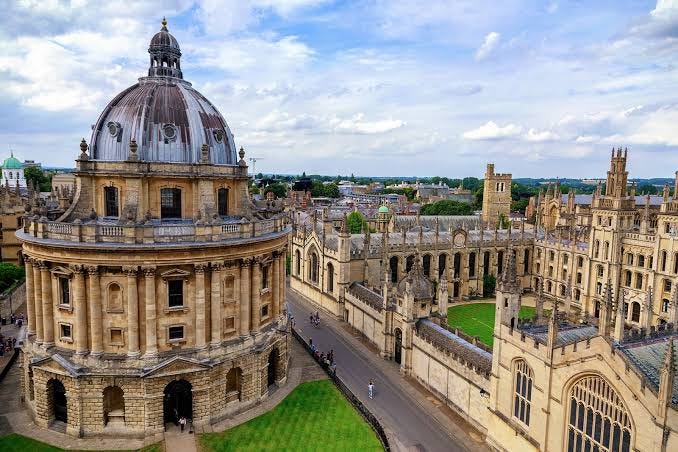
Our national obsession with schooling, most ubiquitously with Oxbridge, highlights a continued provincialism relying upon credentials to impress others and validate ourselves. Defining ourselves by the schools which we attend is not only self-destructive but blinds us to virtues that we should prioritise beyond ‘merit’. If we continue to drag ourselves towards the self-fulfilling prophecy that the cream always rise to the top, then we miss the glories and promise of the defined ‘middle’ and ‘bottom’. A life worth living beyond the simple and mistaken measure of one’s academic and professional accomplishments. Of course, this assumes the very best always go to Oxbridge, a claim which should be met with at least some skepticism.
We can see the reflection of our obsession in the film, An Education, where the precocious Jenny and her hope-filled working class parents live in hope of an Oxbridge acceptance. Naturally, Jenny and her parents are seduced by a slippery conman promising connections to the magical Oxbridge, leading her briefly onto the path of ruin. When his deception is eventually uncovered, Jenny lashes out at her gullible parents for living vicariously through her ambition, outstripping their own meagre existence. But, in the end, she makes it to Oxbridge and redemption is found. So, all apparently ends well with enough elbow grease and an unnatural intellect.
The attempts from Oxbridge to ‘level the playing field’ have been controversial in every quarter. From accusations of unfairness and a lowering of academic standards, to the still uneven acceptance split between applications of state and private school student, the stakes feel that they could not be higher. Indeed, the many tutors and organisations trading off the name and preparing wannabe students is its own micro economy. But, even if Oxbridge could somehow become absolutely meritocratic, which it cannot, this still misses the point over the unhealthiness of our obsession of identifying the ‘best’.
Whereas breeding has become increasingly less important, Downton Abbey and its values of noblesse oblige feel a lifetime away for the vast majority, the new model of importance remains intellectual achievement. Our obsession with Oxbridge is not merely due to the mysticism drifting from those colleges, it is because finding your way to these ancient halls is the ultimate manifestation of winning the meritocratic game. To enter those gates and live in those rooms, you must have earned it. There are no ‘easy roads’ to Oxbridge and supposedly success awaits for each one of their esteemed graduates.
We tell ourselves, and each other, that we get what we deserve. Besides the fact that this is rarely true (how do we decide between the preternaturally intelligent and the hard worker?) merit remains a slippery slope to base any order off. Both Christopher Lasch and Michael Sandel have warned about the dangers of merit forming the primary locus of morality in economic affairs. For Lasch, the focus on merit avoided the harder conversations of simply adopting aristocratic organisational principles around what we have supposedly earned. In the case of Sandel, the role of chance plays too big a role in defining who enters the elite to call it ‘merit’. There are too few places at elite institutions to justify a genuine classification between those who deserve to get in and those who do not make it. The long odds of success are precisely why some attempt to rig the game in their favour emphasising the fragility of any ‘meritocratic’ system.
Oxbridge will be genuinely beyond the wildest dreams of most sixth formers, but the problem here is the number of disadvantaged teenagers who do not have dreams.
Measures of merit are hard to disentangle from economic advantage. Standardized tests such as the SAT purport to measure merit. In practice, however, SAT scores closely track family income. The richer a student’s family, the higher the score he or she is likely to receive.
At this point, I should clarify that I attended neither Oxford or Cambridge. As a teen, I was work shy and far from brilliant enough to make up for my laziness, not only did I not attend, I did not have a sniff of attending as an undergraduate. Of course, I had heard of Oxbridge but these were as close to me as Narnia was. Their mythical status was only accessible via my Inspector Morse DVD collection (yes, it appears I was born a middle-aged man) as opposed to anything that I could truly touch.
In truth, like many, I was not aware of the distinctions between different universities. Their names, fancy crests, and overly large campuses intimidated me and beyond a crude league table ranking found online, I had little idea which ones were the best to apply to. It was a rare instance where I genuinely felt completely out of my depth.
Instead of talking to familial connections about where best to study, I did what millions of eighteen year olds do- I randomly selected some brochures of institutions which sat around my grade boundaries. They piled high in my room, collecting dust as they loomed over me from the corner. The size of the stack and thickness of the brochures themselves aggressively stalked me as I remained unsure about where to begin, let alone make a decision. My mum and dad always tried to engage me on the subject of where I wanted to study. But, in truth, I am not entirely sure any of us really had much more idea than the other about what would make a ‘good fit’.
This is not unusual and represents a continued failure of our educational system. It is not that Oxbridge represent the only excellent schools, it is that students rarely understand what makes a school the correct fit for them. We are always told to find the highest ranked one which will accept us. Reach for the stars as S-Club 7 says. Yet, rankings give no indication of the cultural fit or course selection that defines the best pathway for young people just beginning their academic careers.
Attending the open days was rarely any better. I dawdled around different campuses feeling horribly out of my depth in a perpetual state of confusion about what all the information really meant. Students showing me around with wide smiles appeared closer to the recently converted of a cult than genuine interlocutors. From my eyes, looking boundlessly upwards, engaging in a meaningful and well-informed discussion about where I wanted to study was impossible. I have seen this for myself on the other side of the fence at open days. Prospective students and their families either come armed with well-prepared questions or wander around looking confused about what to do or who to speak to.
The road to choosing my place of study was long, winding, and full of tempestuous emotions. It was difficult enough without the burden of a national conversation judging me for where I decided to go. Our attitude towards schooling, geared towards not simply the good and very good, but the excellent, undermines the potential intellectual and ethical goods arriving from widespread university education. Our focus on the elite blinds us to genuine accomplishment of the many.
This obsessive debate around Oxford and Cambridge admissions will never go away. One royal commission in 1922 argued that who gets access and who doesn’t has been an ongoing problem ever since the Reformation, when the flow of monks and friars into the colleges stopped and “the proportion of country gentlemen’s sons increased.” But in more recent times, the terms of the admissions debate have changed little, with the same underlying assumptions never questioned by either side.
I attended a so-called ‘plate glass’ university- erected in the post-war era, providing the backbone for the initial expansion of education. I worked hard to get there, and I am proud to call myself an alum of that institution (University of Lancaster). My lecturers were inspiring; I made friends who continue to provide laughter, consolation, and love, and I learned an awful lot, not only about my subject but life more generally. It remains a place dear to my heart and soul, and it will do until I shove off my mortal coil.
Despite not attending the two powerhouses of British education, I have friends, acquaintances, and former colleagues who attended one of Oxford or Cambridge. Unsurprisingly, they mostly repeat what I have just written. As it turns out, where you spend your formative adult years and how you spend them gives you the gift and curse of a nostalgia that follows us all. Yet, for these select few, their nostalgia, unlike almost anyone else’s, is subject to national debate and judgement. Because they went to Oxbridge.
The power of institutions where you spend your formative years unsurprisingly paves the path for your future self. Not simply of where you end up but how you conceptualise the world around you. For some, inevitably elitist snobbery will follow, others will be humble, and some may even be embarrassed. Nevertheless, the problems lie not with the people who attended such institutions, but the broader framework of educational elitism that remains firmly entrenched in the UK.
The question of if an Oxbridge education is ‘better’ than a non-Oxbridge one remains highly discussed. The bigger question of if other institutions could replicate a similar model if they chose is disastrously under discussed. In the world of AI where the traditional essay is dying there is little doubt in the humanities most institutions will return to oral or per formatively critical traditions to assess their students. Perhaps we are all heading to the ‘Oxbridge’ way because of these new circumstances.
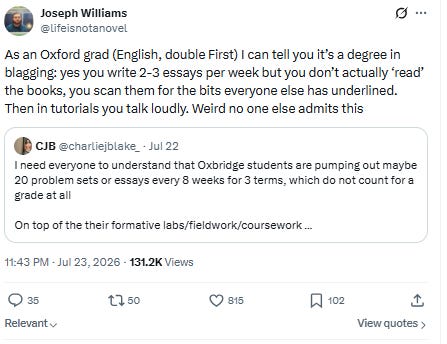
(A joke post many took seriously)
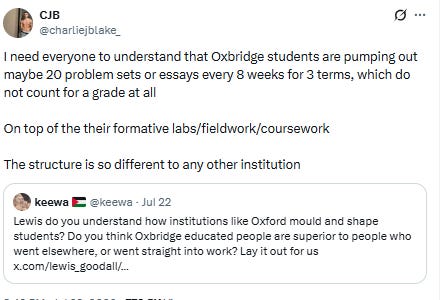
(A supposedly serious approach)
The fiery debate online, and of course we should never confuse the terminally online for the concrete, does highlight the rot that pervades our discourse. Our obsession with Oxbridge is not truly an obsession with the places themselves. They remain downstream from the obsession of identifying the very best and hoping that unleashing the genius will perform some secular miracle. I am doubtful of this.
Instead of focusing on these two institutions, we should re-focus our efforts on the wider effects of university in general. Beyond that of merit, social mobility, but towards an intrinsic good- that learning allows us to examine our own and others lives in greater depth. This is not the same as promising moral beings. The ranks of the SS were filled with PhD’s, but it does give us additional space to truly investigate what we think we should be and what we should do.
This approach does not diminish the effects or recognition of the cultural and social domination of these two establishments. If anything, by trying to change the conversation away from merit, it enhances our chances of truly diversifying our world. The two universities are so universally acknowledged to be the best, no amount of social re-engineering on the same conversation will alter the outcomes. Instead of competing over who has the biggest educational dick, we should grow up and dig deeper.